

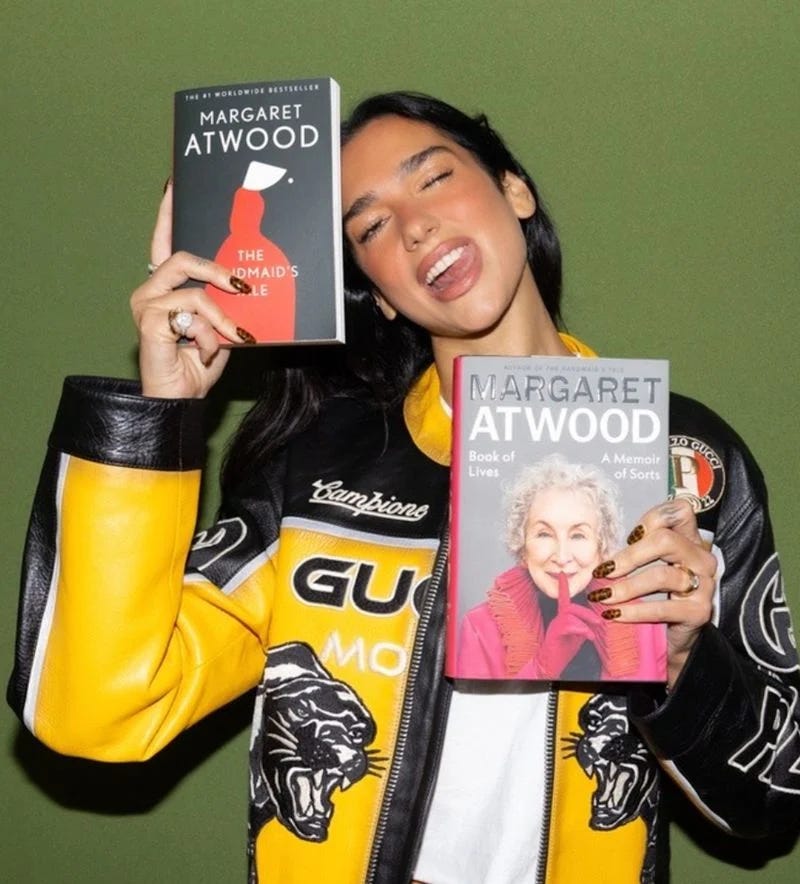
The moment I heard Dua Lipa was curating a list of ‘banned’ books, the first thing I knew for certain was that these books would definitely not be, in fact, banned.
For a start it’s a tautology to point out that if they were banned she couldn’t easily get hold of them and display them in a famous bookshop (Livraria Lello in Porto).
Secondly, there’s zero chance a famous mainstream pop star would decide to obliterate her career with anything genuinely controversial. ‘The Dua Lipa David Irving Collection’ would make a funny meme—as when dense and edgy political viewpoints are jokingly attributed online to Sydney Sweeney or Lana Del Rey—but it would likely not be much of a career boost.
And thirdly, I am dimly aware of similarly-named sections in high street bookshops, which invariably contain the least banned books on the planet.
Hence I was able to guess much of Lipa’s list without even seeing it (A Clockwork Orange, 1984 etc), yet it turned out to be even more mainstream than I imagined. These are books I studied at school (The Handmaid’s Tale) and university (Invisible Man, Things Fall Apart).
Which doesn’t mean they’re all bad, nor do I really mind that they weren’t all literally banned. As Vogue Adria explains: ‘The collection also includes books that may never have been formally banned but have nevertheless questioned existing structures of power or the suppression of individual and collective voices’.
What I do mind is that the list borrows the cachet of works that are bold artistic achievements, some published in genuinely hostile circumstances, and segues into books that uphold the current ideological orthodoxy.
This is most notable in the ‘Voice’ section, which, we’re told, ‘amplifies voices that have historically or systematically been marginalised, excluded or underrepresented’.
Here we have Salinger’s The Catcher in the Rye, but also works like Gender Queer by Maia Kobabe, and Stamped: Racism, Antiracism, and You, by Jason Reynolds and Ibram X. Kendi. Thus Lipa, or whoever has helped her come up with this list, attempts a sleight of hand. The implication is that the liberal era of individual genius and freedom of expression leads naturally to the Woke era of radical leftism, aggressive conformity, and cancel culture.
Of course there are postliberal thinkers who would agree with this, but they would mean it in the negative sense that liberalism’s inherent logic guaranteed its own demise in the form of Woke. Others, like Andrew Doyle, believe Woke is a hard break with liberalism—a hostile force attacking it from the outside.
Lipa’s list falls within the first camp, with the key distinction that she is implicitly claiming this progression into Woke is a good thing. Just as few Woke ideologues even now will admit to being against free speech, Lipa knows that there is something good and important about the literary achievements of the past, and tries to harness that energy to bolster the oppressive contemporary ideology her list ultimately advocates.
We can see this hypocrisy in, for example, the fact that publishers have relentlessly weeded out the Salingers of today. Catcher would be instantly dismissed as the narcissistic ramblings of a privileged white male, and would not have a hope of being published. In that sense it really is ‘banned’ in spirit, but that is certainly not what Lipa means by the term.
William Burroughs also features, yet he would definitely be cancelled today, and probably in jail (the latter perhaps a reasonable outcome from shooting your wife in the head). Burroughs’s Naked Lunch is in the ‘Control’ section, along with Kafka’s The Trial. These are apparently works that ‘explore the mechanisms of control, both visible and invisible, including surveillance, propaganda, technological influence and ideological conditioning.’
It’s hard not to laugh at the last part, in a list stuffed with works on decolonisation, ‘antiracism’, and gender ideology. But there is also little evidence the Woke authors on this list offer a real critique of bureaucracy or technocracy, and typically the Woke were the most fierce enforcers of state tyranny during the Covid era (along with Piers Morgan).
The Handmaid’s Tale also appears in this section, and is the perfect representative of the whole list. It imagines an oppressive Christian patriarchy which in many ways resembles the real Islamic patriarchies that are in operation in parts of the world right now. As with Lipa’s list, it is far safer to create a straw man opponent and pretend you’re ‘banned’.
This is why the one genuinely brave choice on the list is Salman Rushdie’s The Satanic Verses. One key distinction between the liberal and Woke eras has been the latter’s tendency to ignore Islamic oppression in favour of viewing all Muslims as victims of the West. Rushdie exists on the faultline between these two worldviews, and it would have been typical for a list like this to duck controversy by not including him. This almost makes me think he is there by mistake, or perhaps it’s because Lipa’s library is in Portugal, where they may not have got the latest Woke memo, much in the way that Michel Houellebecq is still allowed to be a literary star in France.
Rushdie’s horrific stabbing in 2022 proves that this book is still highly dangerous. The rest are largely classics that are no longer considered controversial, or, to the extent that they are, it is at the hands of the kinds of people behind the more recent works on the list. It is they who love to tear apart the canon and let loose ‘sensitivity readers’ upon the very giants on display here.
Lipa doesn’t look like she eats a great deal of cake, and that is to her credit, but here she is trying to have her cake and eat it. You either celebrate beauty, individual expression, and artistic risk, or ‘identity’, ideological conformity, and activism posing as art. You can’t have both.
Well said. I'm not sure what's more aggravating: the fact that this objectionable airhead is pretending she came up with this list of books, or the fact that the actual person who was her supposedly 'smart' advisor on this came up with this list of books.
The subconscious thought process that underlies all of these selections is merely, "these are smart books that smart people would agree are smart. I'm very smart because I'm like the smart people." What unites the worldview of Kafka and Kendi? Nothing beyond the fact that someone 'smart' would know who both are and probably have read them.
So again I return to being unsure of what I detest most: Lipa herself or whoever advised her. Scratch that, I hate both. And modernity.
Great analysis Nick.