

I was always sceptical of Long Covid, and remain so. But lately I have been suffering from an equally mysterious condition known as ‘Long 90s’. This is the ailment whereby one feels a sudden and almost unbearable desire to return to the 1990s. It can strike at any time, in some cases lasts several days, and particularly affects men over 40.
During acute attacks the only thing I’ve found that brings some relief is listening to medicinal amounts of Britpop on Spotify. And not just Oasis and Blur. I’m talking about Shed Seven, Dodgy, and, yes, even Gene. I hear in extreme cases people have been known to play up to two songs by Echobelly.
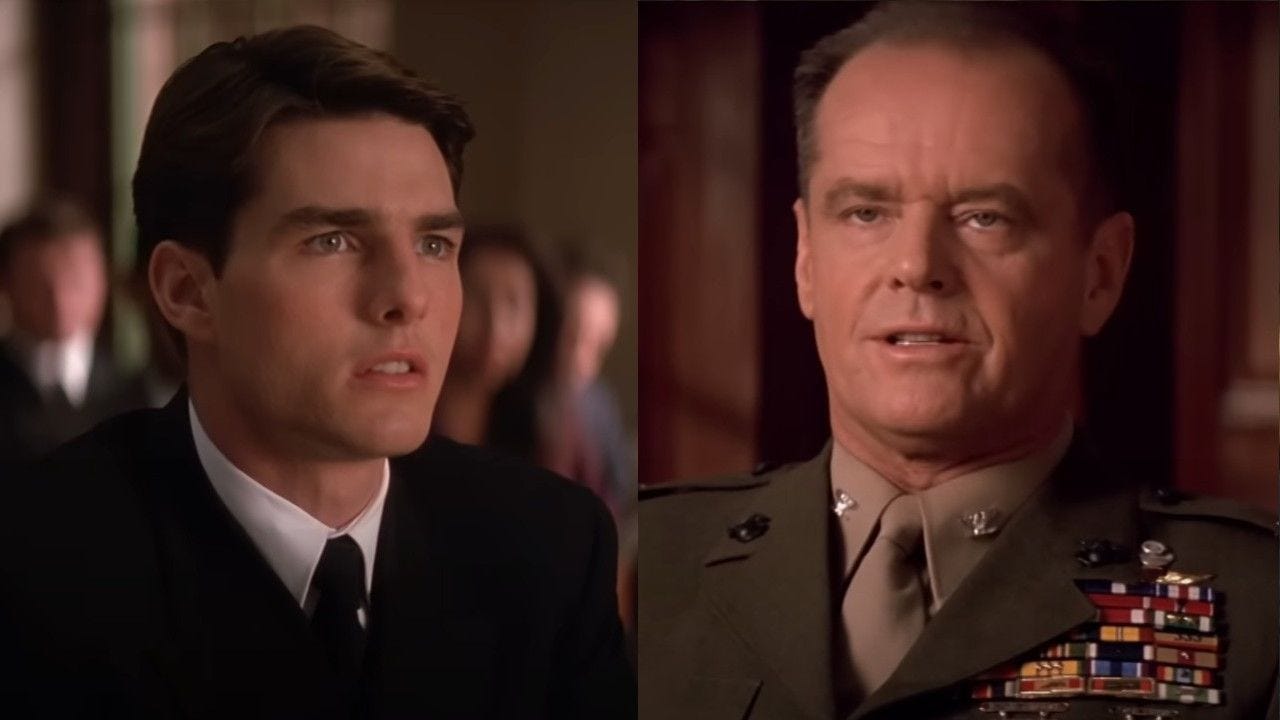
Suffering a moderate bout the other night, I found myself watching A Few Good Men for the eight trillionth time. It then hit me, as if roused from my sleep by an especially violent ‘Code Red’, that the movie is now 34 years old. In other words, it would be like someone from 1992 (when the film came out) watching a film from 1958. That is simply unacceptable.
I still see the movie as essentially contemporary. I feel it came out ‘a while ago’. But no. It’s equivalent to childhood me, firmly ensconced in the loving bosom of the 90s, sitting down to watch something in black and white about dames and plucky shoeshine boys who say ‘Aw shucks mister’.
And that actually is the right comparison, because the 90s were wholesome. Look at the warm, soft colours, the subtle grading, the knitted sweaters. The worst swear word was ‘sonofabitch’ (see the thrilling 1997 movie Breakdown, where Kurt Russell is unable to countenance a more scathing epithet for the relentlessly evil psychopaths who have kidnapped his wife). There was a successful film about fly fishing, for pity’s sake. It was beautiful and almost nothing happened. Just like the entire decade.
The 90s is now the distant past. It is another era. But it was—all complaints about the Gulf War, Tony Blair, and Nu metal aside—the last good time there was. It may have been the last time period. I don’t mean the last time period but the last time—period. The end of history. True, that didn’t work out in the sense that Mr Fukuyama meant (essentially that liberal democracy had absolutely nailed it once and for all), but I do feel like history kind of did actually end.
Because after that what has there been? The noughties (Americans call them the ‘oughts’ apparently—odd folks) were essentially a continuation of the 90s, just with everything mildly worse but still highly comforting. Then after 2010 it all falls apart very quickly. Probably after 2008 really, and the rest was just catching up to the crash whose domino effects were already inevitable.
The signs of decline were there even in the 90s, of course. I describe the Gen X era as the blue cheese days. Yes there was already mould, but what delicious mould! Nihilism was ubiquitous, from Fight Club to Grunge. But it wasn’t that serious. In hindsight the grievances seem like the bleatings of emo kids not realising they’re still basking in the glow of a coherent society and functioning economy. Things worked. Ultra-competent men with massive budgets directed movies that the whole world saw. And they were bloody good.
A Few Good Men was one such movie. I can’t help but see the fact that Rob Reiner directed it, and more recently developed Trump Derangement Syndrome then got murdered by his own son (allegedly) as some kind of sign of decline. And not a particularly subtle one.
And even though the liberal messaging is all there, it is relatively subtle. Yes, the mentality that sees the lawyers in A Few Good Men persecuting the military eventually gets you to Keir Starmer. But there was still a long way to go before that in 1992. And the always excellent if occasionally annoying Aaron Sorkin even gives the ‘baddies’ (AKA military personnel who bravely sacrifice their lives to protect cocky lawyers) some great lines. Speaking of which:
What did Jack Nicholson say to the lady who asked for an Italian, aromatised, fortified wine?
Vermouth? You can’t handle Vermouth!
You’re welcome.
Even with the clear liberal bias, this was still the pomp of the American Empire, where even the left were revelling in Manifest Destiny. Tom Cruise at this point was virtually a Weapon of Mass Destruction. Even the nerdy autistic woman was played by *checks notes* Demi Moore. And no one thought that was ridiculous. Well, a bit. Kevin Pollak was still working regularly. And darn good he was too. In both this and The Usual Suspects three years later. He had a particular look that you only saw in the 90s. A certain receding hairline and sweater tied around shoulders combo you simply don’t come across anymore. We have lost so much.
And how did we lose it? The West didn’t stand up for its values. Just as the lawyers in the film (except Demi) don’t value the men who stand on that wall protecting us, the culture that produced films like this didn’t value what made us great, and what made such movies possible in the first place. Of course, that’s just one of a million things that went wrong. As the quote goes from one of the last great movies, No Country For Old Men (which is somehow twenty years old): ‘It’s the dismal tide. It’s not the one thing’.
Now everything is falling apart. Random acts of primitive, gory violence occur daily in your local town. Civl unrest in the United Kingdom will reach new levels this summer. With the possible exception of Amazon deliveries, absolutely nothing works anymore, from the publishing of literary fiction to your local bin collection. People don’t even pick up after their dogs, litter is everywhere—oh and we have land wars in Europe and teenage boys killed for being white. One day even Fraser Nelson will admit it’s not working out. It’s time we started handling the truth.
Being older, I get similar feelings about the 80s. A lot of it has to do with the way we’re communicating now. I mean right now. No social media or internet in the 80s with all the problems (and benefits of course) that it brings. Plus the politicians we’ve had since then have almost all been diabolical - evil, if you like.
The one glimmer of hope I still cling to is that the transformation of Britain has been so rapid that midlifers still remember the Before Times. If we could just get ourselves organised, we could be the vanguard for Restoration.