

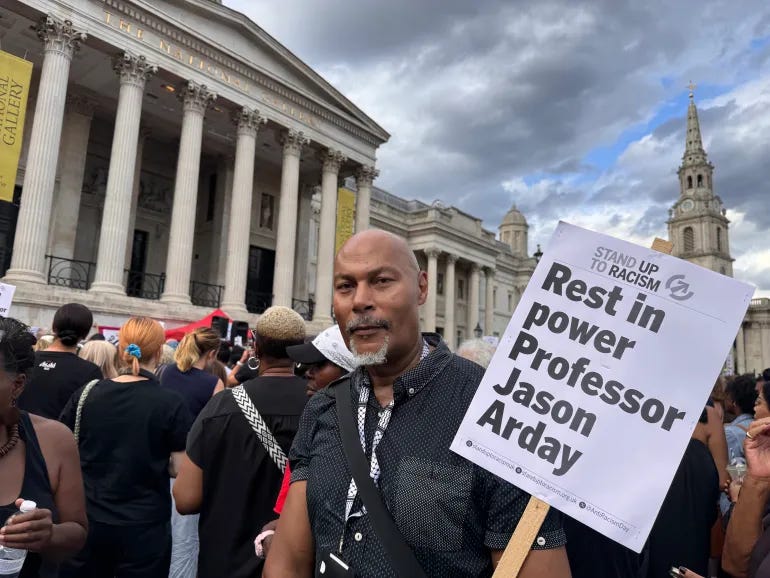
All suicides are tragic. My own family has not been spared this particular misery, and it is absolutely devastating. When I heard Jason Arday had killed himself, I felt sick, and you will not see me making light of it on social media.
However, we already appear to have moved into a new phase where the real Arday fades away, and an idealised, saintlike figure emerges.
At the vigil for Arday in Trafalgar Square, the prevailing mood was incoherent anger combined with wild revisionism.
The term ‘lynching’ has already been used to describe what happened to Arday, and one speaker, grasping for an even more hyperbolic term, claimed this was a ‘public assassination’.
At one point the crowd chanted Arday’s name over and over, like a scene from Fight Club, or a cult about to indulge in a ritual sacrifice or act of mass violence.
If the term ‘post-truth’ ever applied, it is here. Reason, facts, and logic have been entirely swept away in a torrent of rage, the targets of which are highly selective.
It doesn’t matter that Cambridge University is more responsible for Arday’s fate than the media, or that the left-wing Guardian eventually exposed Arday as robustly as any other outlet. Nor do Arday’s own choices, from the lies he told to his final tragic decision, seem to play a part.
Instead, we get a very simple narrative: the right-wing (white) media killed (lynched) a black man.
It is one part woke textbook, one part American history, and one part George Floyd. It has nothing to do with truth, and everything to do with identity.
Like all simplistic narratives, it has an arch-villain. In this case it is Nathan Cofnas, a Jewish scholar who has become the unlikely face of white supremacy.
Everyone from Dan Neidle to J.K. Rowling has called him racist, while Diane Abbott and others scream about him from a makeshift stage in Trafalgar Square.
