

By now we are all painfully aware of the demonic glee with which a disturbingly large segment of the population greets any new death of a person they don’t like.
But the very sad news about Rod Liddle seems to have brought out another variation on this theme, or perhaps a change in emphasis, along with some signs that an increasing number of people are sick of this morbid trend.
There is a fundamental divide here between what I will call ‘normal people’—i.e. those who see death as the moment to emphasise a person’s good qualities and leave out their inevitable flaws—and those horrible bot-like beings for whom someone’s death is the ideal opportunity to demonstrate conformity to the prevailing ideology, strangely by indulging in an orgy of hatred that they have convinced themselves is somehow appropriate and merited.
What became clear following the death of Rod Liddle—and this is what I mean by a change in emphasis—was the mindless degree to which people appeared to be arbitrarily looking for the handful of items they could use to justify their feral outbursts of rage.
It’s as if, upon hearing of this latest death, they leapt up to access some file of alleged transgressions that they could tick off in order to avoid the complex demands of being human.
In Liddle’s case, this meant the headlines of a few articles they almost certainly hadn’t read or understood. These were enough to call him every word under the sun, and repeatedly state how glad they were that he had died. One account replied to absolutely every post about Liddle with these sentiments, to the point where I had to stop scrolling—there was simply too much. Naturally, it was a Scouser.
I include that last line as the exact kind of thing these humourless cretins would use as proof that a person should be entirely banished from society.
As I say, the key difference between our traditional approach and this new breed of hysterical death detectives is that while we look for the good at this moment of sorrow and mourning, they immediately seek out the bad. From a standpoint of traditional morality, it’s hard to see what they’re doing as anything other than evil, and that indeed is my position.
If I had to try to steel man the Devil, I suppose I’d say that to their hivemind, anyone setting back ‘progress’ towards their utopia is inherently doing something bad, so any attack on them becomes a kind of good.
That’s my best attempt, though I admit it’s hard to fairly represent such a vaccuous worldview. Utopianism is always stupid, and this lot don’t even have cool uniforms.
Some attacks even came from those broadly on ‘our side’, such as Bev Turner, who, linking to an article where Liddle comments on so-called anti-vaxxers, said ‘I used to love Rod Liddle. He was always in on the joke. Then he said this about people who had done their own research and I realised he wasn't what I had thought.’
It should be obvious that this kind of thing is not appropriate upon someone’s death. I personally despised Bev’s ill-informed and extremely radical pro-abortion rant on GB News, but if anything happened to her there would be zero chance of me tweeting about it. In fact I’ve never mentioned it before, and only bring it up now to make my point.
The standard ‘I didn’t agree with everything X said BUT’ is comically redundant in the case of Liddle. I doubt there is a soul on earth who agreed with everything he said. The free-thinking nature this implies is one of the things Liddle has been most praised for, along with his personal kindness and integrity.
This is how it should be. Seeking the good sometimes means praising one side of the same coin. In this case, it’s clear that free-thinking will almost certainly entail occasional or even frequent disagreement. Thus it is not necessary to bring up the latter at the moment of someone’s passing, and in doing so you creep into territory occupied by the ideologues whose primary value, if we can even call it that, is adherence to doctrine.
To be generous, there has been immense pressure on people in recent years to behave like ideological robots. This has somehow become the high status position, to the point that traducing someone upon their death is seen by many as not just ‘a bit off’, but actually the morally superior path. Hence the wild, unencumbered alacrity to do just this that we see from so many NPCs of the current cult.
But, as I hinted at the beginning, there are mildly encouraging signs that many are getting tired of pretending humans can be expected to meet some protean and frequently absurd ideological standard, and that they should be forever judged according to these grim criteria.
See, for instance, Jeremy Vine’s excellent tribute to Liddle. Though a reply stating ‘I'm surprised at you for posting this Jeremy. What was your view on the article he wrote saying he wanted to string piano wire across roads to decapitate cyclists?’ is a perfect example of the humourless puritanism of the new Bots.
Vine’s reply to this is a succinct expression of the old morality some of us still uphold: ‘He overstated everything for effect. I'm really sad he's left us. He was so talented and funny. Like many people he also made mistakes. I don't want to focus on them today.’
I don’t want to focus on them today. This used to be the standard view, but now needs to be spelled out for the apparently endless stream of nasty morons on social media.
Rosie Duffield, Kathleen Stock, and Julie Bindel also paid tribute. Duffield then met with the inevitable tide of idiocy, to the point where she added a second post stating: ‘It is not my job to like the same people as you, or come to the exact same conclusions about people simply because of the threat of potentially offending you by liking someone you've decided is a *bad person*.’
Perhaps all these staunch defences are just a result of the number of friends Liddle had in politics and media. But it does appear to me that more and more people are growing weary of being constantly berated by the Borg-like proponents of political correctness.
Although some in the Terfosphere(?) may have their limits on who they would defend, it might be that here we see the real divide in the culture war. On one side are those who retain a traditional and very British conception of decency, flexibility, humour, and an empathetic acknowledgement of what it is to be human.
On the other are the puritans who pretend to be perfect robots, and strangely express this, for reasons discussed, through the medium of being as overtly vile as possible, at the least appropriate possible moment.
Naturally the motto of these people is ‘be kind’. Yet if we do the exact opposite to them in every single instance, we will be much closer to that difficult yet noble aspiration.
All I'll say is " a good article Nick". I think you nailed it. He was just human wasn't he.
So well put, Nick. Hearing about some of the things people were saying within seconds of learning of the guy’s death, I despaired. You just lose faith in human nature sometimes. I like how you have delved deeper into it here.
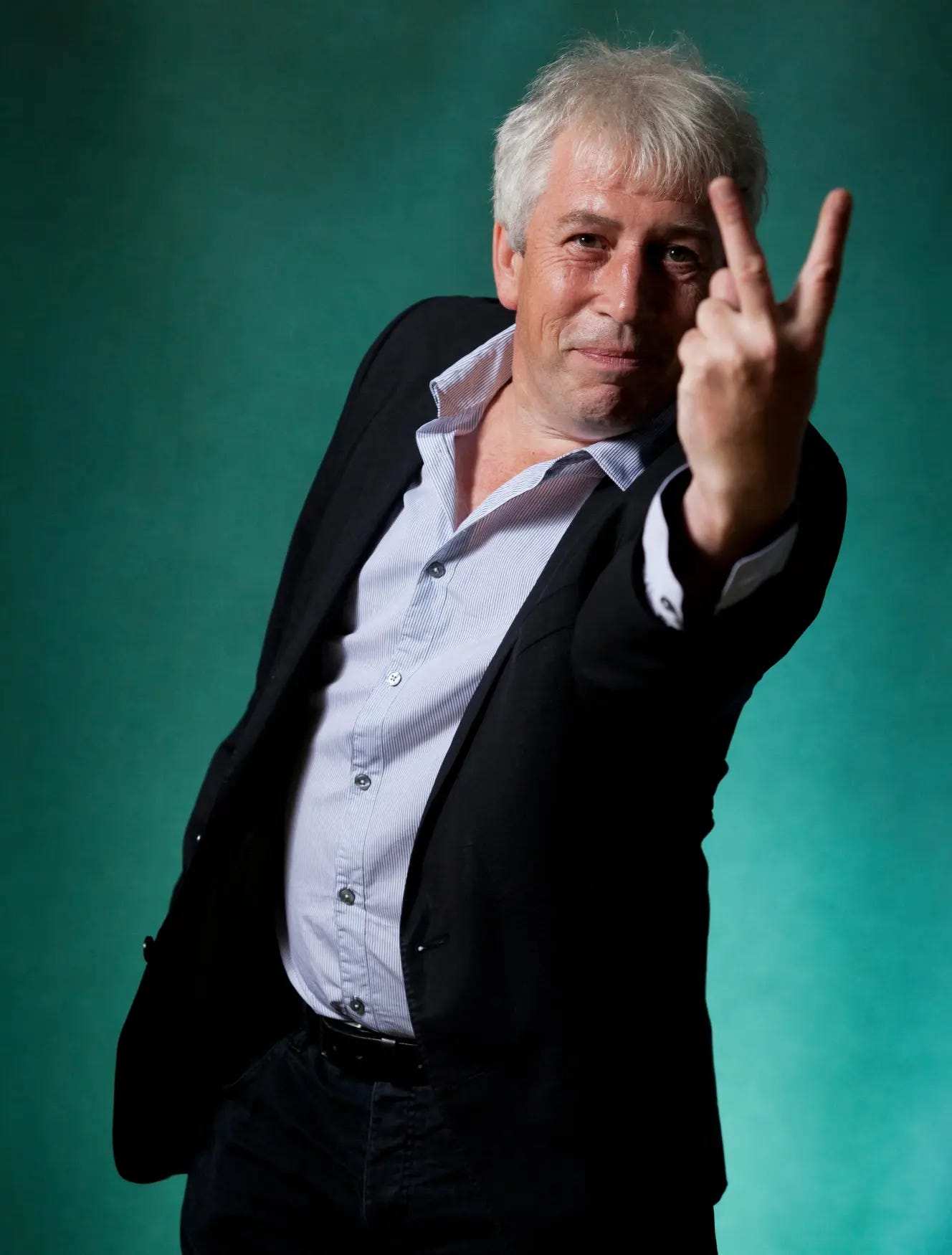
I take solace in the fact that if Rod is looking on, wherever he may now be, he is probably doing exactly what he’s doing in the photo above to those people who were falling over each other in their clamour to make the lowest comment.